A First Community Zine, Planned Around One Question
Plan a first community zine around one shared question, with a simple format that welcomes different contributions and helps your group choose a fitting approach.
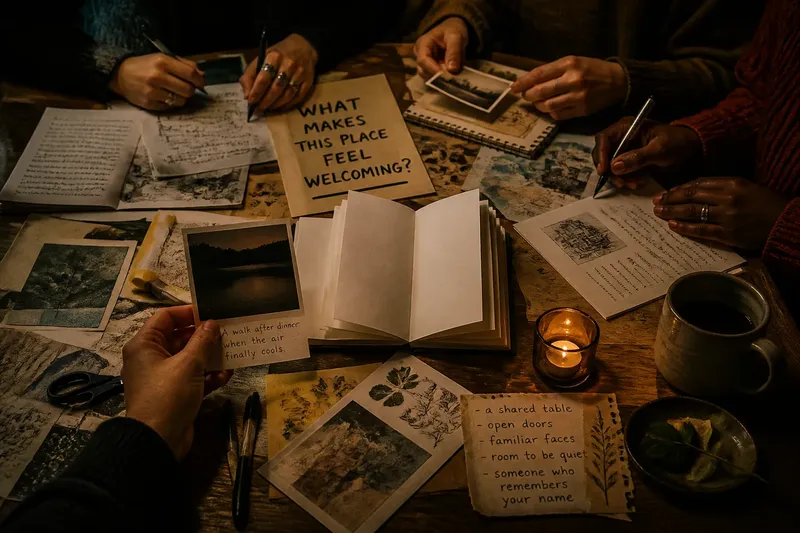
A first community zine works best when one shared question gives every contribution a point of connection. Choose a question people can answer in different ways, then select a format that suits the group’s time, materials, and comfort with making things public.
The question is a prompt, not a test of agreement. A zine can hold sketches beside short notes, recipes beside memories, or a list beside a poem. The useful planning decision is how much structure to offer: a loose collection, a sequence of pages, or a shared visual pattern. Each approach creates a different kind of reading experience.
Choose the question
Start with a question tied to the occasion for making the zine. A neighborhood gathering might ask, “What makes this place feel welcoming?” A group of friends might ask, “What do we want to carry into the next season?” Keep the wording open enough that nobody needs specialized knowledge or a single correct answer.
Check that the question can invite more than one kind of response. “What is your favorite local café?” may lead to a useful collection, but it narrows the subject to people who visit cafés. “Where do you find a moment of pause?” can welcome a drawing, a remembered scene, a sound, a place, or a small everyday ritual.
Before inviting contributions, say what the question is for and who will read the zine. If the topic touches personal or sensitive experiences, let contributors pass, use a pseudonym, or submit something that does not disclose private details. Decide together whether names, contact information, or identifying locations belong in the finished pages.
Three page approaches
Open contribution collection
In an open collection, each person makes a response in a form they choose. One page might hold a paragraph; another might contain a collage, a small map, or a recipe with a note about its meaning. This option suits groups with varied skills, limited planning time, or members who do not all want to work in the same medium.
The tradeoff is that the pages may feel unrelated. Give contributors a few practical boundaries, such as a shared page size, a common question, and a deadline for handing in finished work. Avoid asking everyone to imitate one visual style; the shared prompt already provides a connection.
Question-and-response sequence
A sequence arranges pages so one response leads into the next. Contributors can respond to a phrase, image, or idea from the previous page while still answering the central question in their own way. This suits groups that enjoy conversation and want the zine to feel like an exchange rather than a set of individual statements.
It takes more coordination because someone must arrange the order and check that each contribution can be passed along. Set a clear handoff: for instance, one person shares a page draft with the next contributor, who may echo, question, or visually answer one element. Contributors should be free to decline a direct response if the material feels too personal.
Repeated page frame
A repeated frame gives every page the same simple structure, such as a prompt line, an image area, and a short caption. This suits a group that wants a coherent-looking issue or needs a format that is easy to assemble and duplicate. Contributors still choose what to say and how to say it within the frame.
The tradeoff is that a fixed template can make unusual forms harder to include. Leave at least one area flexible, or allow contributors to turn the frame sideways, extend it, or replace one element. A repeated structure should make participation easier, not make every answer look alike.
How should you choose?
Which approach suits a group with mixed skills?
Choose the open collection if contributors have different levels of confidence or prefer different media. Offer examples of possible forms without presenting them as requirements, and agree on only the boundaries needed to assemble the pages.
Which approach makes the zine feel conversational?
Choose a question-and-response sequence when members want to notice and build on one another’s ideas. Keep the handoffs voluntary and assign someone to arrange the pages so contributors are not left guessing how their work moves forward.
Which approach is easiest to assemble?
Choose a repeated page frame when the group wants a consistent layout and a straightforward assembly session. Use a frame with room for different kinds of content, then decide who will collect pages and prepare the master copy.
Can the approaches be combined?
Yes, if the combination has a clear reason. A repeated frame can organize an open collection, or a sequence can include a few pages that stand alone; choose one approach as the main structure so contributors understand what they are making.
For a first issue, choose the open collection when variety matters most, the sequence when exchange is the point, and the repeated frame when visual unity matters most. If the group is unsure, ask what it wants a reader to notice: many distinct voices, a developing conversation, or a recognizable shared shape.
Set the working agreement
Before anyone makes a page, settle the small decisions that prevent avoidable friction. A short note in the group’s shared document can cover:
- The central question and the intended readers.
- Whether contributions may be written, drawn, photographed, or assembled from found materials.
- The page size or template, if the chosen approach needs one.
- Who collects pages and who makes the final ordering decision.
- How contributors can request edits, anonymity, or removal before printing or sharing.
- Where and how the finished zine will be distributed.
Be clear about permission. A contributor should know whether the zine will be handed around in person, posted online, or both. Get permission for any image, text, or recognizable person that someone else created or appears in; if the group is uncertain about rights or local requirements, consult an appropriate professional.
Agree on a modest scope before collecting work. For example, say you are making a short paper zine for attendees of one community meal, with each person contributing one page or choosing to pass. That gives contributors a concrete starting point without requiring them to fill every available space.
Make room for different forms
Translate the shared question into invitations rather than assignments. Instead of telling everyone to write a paragraph, offer a few ways in: describe a moment, draw a place, list useful objects, share a phrase, or make a small collage. People can also propose another form that fits the question.
Say you are making a zine for a neighborhood potluck and ask, “What makes a place feel welcoming?” One person might draw the shared table, another might write about being greeted by name, and someone else might submit a short list of things they bring when hosting. Those pages differ in form but still speak to the same question.
Plan for accessibility in the way people contribute. Provide a way to submit work by hand, digitally, or through a conversation with someone who can help record it. If a page uses handwriting, make sure it can be read; if a contributor prefers not to draw or write, an agreed collaborator can help shape the contribution while leaving its meaning with the contributor.
Keep the editing process transparent. If a page needs trimming to fit, ask its maker before changing the wording or cropping an image. If the group needs to edit for clarity, spelling, or privacy, state that boundary before collecting contributions and let each person review meaningful changes.
Assemble and share
Gather the pages in one place before assembly. For a paper zine, print or photocopy a small working set, arrange the pages on a table, and read through them in order. Check that the central question remains visible, that no page is accidentally omitted, and that captions or images are legible. If you are making a digital version, view it on the screen or device readers are likely to use.
Give one person responsibility for the final file or master copy, but let contributors inspect the arrangement before it is shared. Ask focused questions: Does the sequence make sense? Is any name or detail included without permission? Does a page need a clearer caption? Avoid reopening settled creative choices unless a contributor raises a concern or the change affects meaning.
Choose distribution that fits the occasion. A zine made for a gathering might be placed on a welcome table or shared with participants afterward. If it will also be posted online, make that a separate choice rather than assuming consent to a paper copy includes consent to broader sharing.
Keep the question useful
A shared question should connect the pages without forcing a single answer. Treat it as an invitation people can interpret, and choose the page approach according to the kind of connection the group wants readers to see.
When planning your first community zine, make one last check before inviting contributions: can someone answer the question in a form they already enjoy, and can they decline without explanation? If both answers are yes, the group has a workable starting point—and enough room for the pages to surprise one another.