How to Build a Pattern Library for Shared Projects
A pattern library helps a group reuse useful practices without copying them blindly. Learn how to record context, tradeoffs, and limits for the next project.
A pattern library helps a group carry useful practices into its next shared project without treating them as universal instructions. Start with a recurring coordination problem, describe the conditions around it, and show how members responded so others can judge what to reuse.
Choose a recurring problem
Begin with a situation that has happened more than once, not with a solution someone wants to promote. Look for friction that affects how people make together: tools become hard to locate, beginners wait for help, or a shared space gets left in a state that slows the next session.
Ask who encounters the problem and what conditions shape it. A crowded room calls for different choices than a quiet one. A group with rotating volunteers may need a different approach from a stable team.
Keep the scope narrow. “Help people collaborate” is too broad to guide a reader. “Make it clear which tools are still in use at a crowded workbench” gives the group a situation it can describe and examine.
Write a usable entry
Give each pattern a short name, then describe the situation, the difficulty, the response, and the tradeoffs. Separate what members observed from what they recommend; readers need to know whether a statement describes an event or proposes a practice.
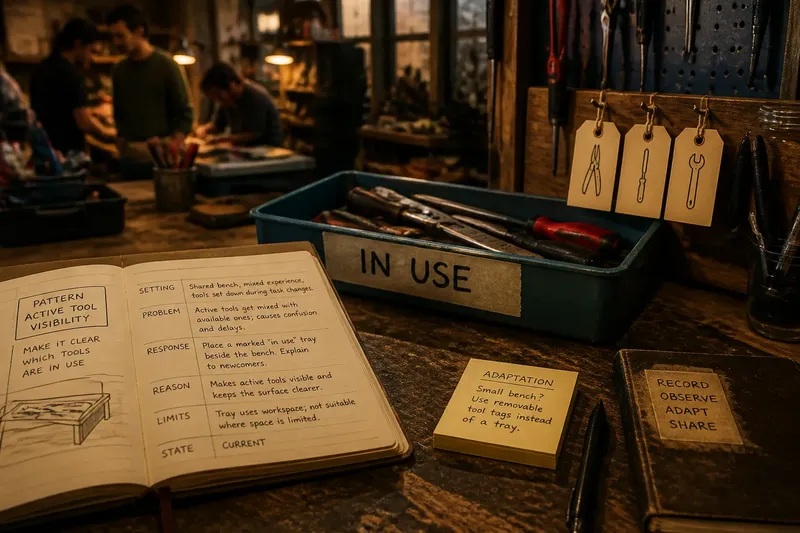
- Name: Use a memorable phrase, such as “Mark the active tool.” If members cannot tell what the title means, choose a clearer one.
- Setting: Identify the activity and relevant conditions, such as a shared repair bench used by people with different experience. If the setting is too vague, add the detail that changes the decision.
- Problem: State what repeatedly gets in the way and who is affected. If the difficulty is not shared or recurring, keep it as a note rather than presenting it as a pattern.
- Response: Describe the actual action members took, such as placing a marked tray beside the bench. If the action depends on an unmentioned resource, name that resource or offer an alternative.
- Reason: Explain why the response seemed suitable and what it made easier. If the reasoning is unclear, ask contributors what they were trying to change.
- Limits: Name conditions where the response may fail, such as a tray that blocks access or a room where tools need controlled storage. If a limit applies, adjust the practice rather than copying it unchanged.
- State: Mark the entry as current, past experiment, or under discussion. If nobody has reviewed it for the current project, present it as a record to consider, not an active direction.
Use plain language and describe roles rather than relying on names that future contributors will not recognize. A reader should be able to see what the group did, why, and what would make another choice sensible.
Compare conditions before reuse
A pattern is useful when it helps a group make a decision, not when it is copied word for word. Compare the original setting with the new one: available space, experience levels, access needs, materials, and who will maintain the practice. If a major condition differs, adapt the response or leave it aside.
Say a volunteer repair group records this starting situation: several people share one bench, tools are often set down during task changes, and unfinished work makes the surface crowded. Members place a clearly marked “in use” tray beside the bench and explain its purpose to newcomers. In a later project, a team has one small bench and limited surface space, so the tray would obstruct work; it instead uses removable tool tags hung beside the bench. The decision is to retain the pattern’s aim—make active tools visible—while changing the method to fit the space.
Record the tradeoff, too. A tray is easy to spot but can consume workspace; tags save surface area but require users to attach and remove them. That comparison gives the next group a real choice rather than a preferred answer disguised as a rule.
Keep entries connected
Organize the collection by the problems members search for, such as “sharing tools,” “learning a task,” or “preparing a work area.” A simple shared document can work if contributors can find entries and update them without needing a specialist to manage the system.
Link related patterns when one practice depends on another. For example, a tool-sharing entry may point to a separate entry about closing the workspace. Keep each entry focused; links let readers follow a connection without repeating the same explanation in several places.
When a practice changes, update its status and explain what changed. If a group stops using a method, preserve the reason as well as the old description. A past experiment can still help members avoid repeating a poor fit, provided it is not mistaken for current guidance.
Questions about pattern libraries?
Is a pattern library a set of templates?
No. A template supplies a structure to fill in, while a pattern describes a recurring situation and a response that may fit it. A group can create a template for recording patterns, but readers still need the context and tradeoffs.
Can an entry describe a failed attempt?
Yes. State what the group tried, what it observed, and which condition made the approach a poor fit. That helps others decide whether the same limitation applies to their project.
Who should review a pattern?
Invite people who use the practice and those who bear its effects to review it. If an entry concerns access, safety, or specialized equipment, seek input from people with relevant experience before treating it as guidance.
How should a group handle disagreement?
Keep the disagreement specific: identify which condition or tradeoff leads members to different choices. Add a note or a linked variation when both approaches may fit different settings; revise the entry if its description leaves readers confused.
A pattern library works best as a decision aid for collective making: it preserves enough detail to compare a past response with the project at hand. Before adopting any pattern, check the setting, the people affected, and the work required to maintain it; those conditions often determine whether an old practice is worth carrying forward.