The Two-Minute Task That Gets a Group Unstuck
A two-minute task helps a group see what a shared project needs before committing to a plan, by making the first uncertainty visible and actionable.
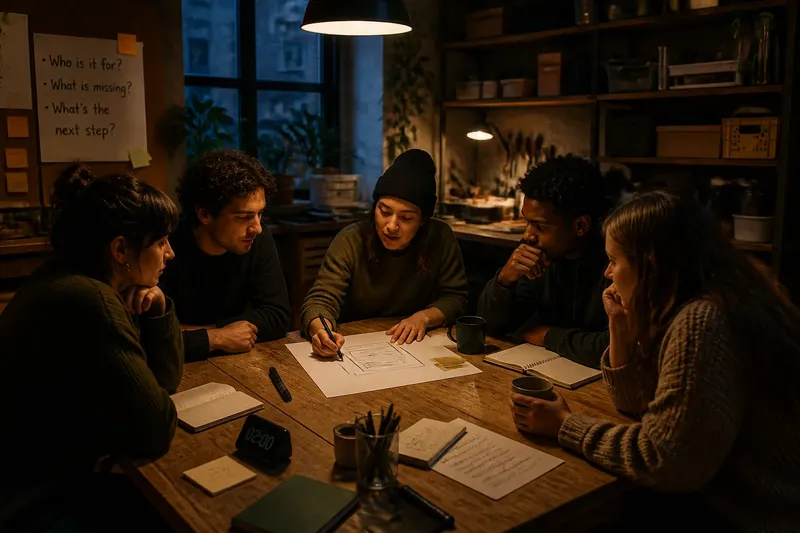
A two-minute task can get a shared project moving by showing the group what is actually missing before anyone commits to a large plan. Instead of debating the whole project, choose one small action that leaves behind something visible: a list of materials, a sample layout, or a question that needs an answer. The result gives everyone a concrete basis for deciding what comes next.
Choose one uncertainty
Start by naming the point that is making the group hesitate. It might be unclear who the work is for, what the finished object should contain, or whether the group has access to a useful space. Keep the uncertainty narrow enough that a brief task can produce evidence about it.
Ask each person to finish this sentence: “Before we plan further, we need to know whether…” Compare the answers and choose one that affects the next decision. If the answers point in several directions, do not try to resolve every concern at once. Pick the question that would change the project’s shape most if the answer were different.
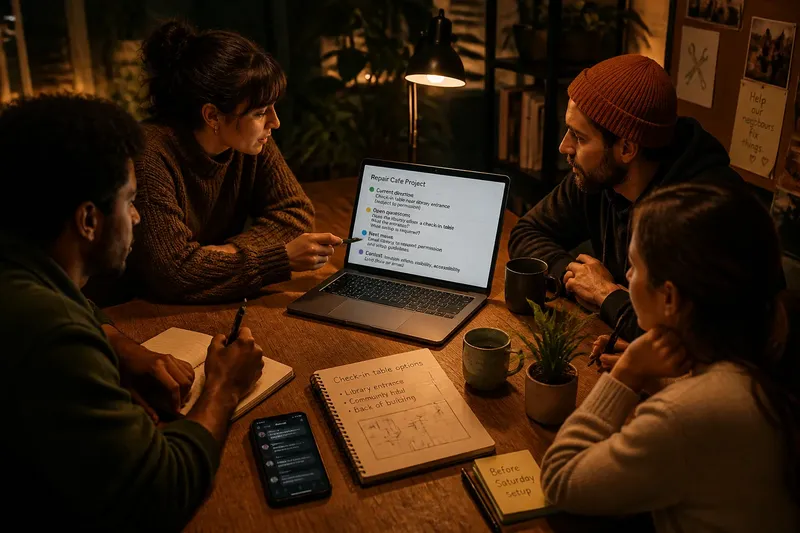
For example, a group considering a neighborhood repair event might be unsure whether people need help identifying repairable items or need a place to borrow tools. That is more useful than beginning with a broad task such as “plan the event.” The smaller question helps the group see what to learn first.
Define a finished trace
A two-minute task should leave something the group can inspect. “Think about the event” has no clear finish. “Write down three items a neighbor might bring” produces a short list. “Check the room” is too open; “write down the room’s available tables and access notes” creates a record.
Set a simple boundary before starting. Agree on the task, who will do it, and what counts as finished. The output can be a note, rough sketch, sample, labeled folder, or unanswered question. It does not need to be polished or ready for public use.
Keep the task small, but do not make it meaningless. A useful first action should touch the actual work, not merely create a feeling of motion. If the project involves making a shared resource, a tiny draft of one section can reveal more than a long conversation about how the final resource might look.
Pick a task that fits
Choose an action that can be started with materials already at hand and stopped cleanly. Avoid tasks that depend on permission, a specialist, a purchase, or a long conversation. If the action cannot be completed in the agreed short window, reduce its scope until it can.
- For a shared event, write one sentence describing who it is for.
- For a group resource, sketch one sample page on paper.
- For a communal workspace, list what people can already use there.
- For a collaborative performance, read one short passage aloud and mark what feels unclear.
- For a neighborhood project, draft one invitation and note what information is missing.
These are starting points, not a menu to complete. Select one task that tests the uncertainty you named. If the output would not help the group make a decision, choose a more relevant task.
Start and stop cleanly
Say the task aloud before anyone begins: “For two minutes, we’ll draft one invitation and mark missing details.” Use a phone timer if that helps the group respect the boundary. Work quietly, or let people contribute in parallel if the task allows it.
When time is up, stop even if the result is rough. The point is not to squeeze a finished deliverable out of a short interval. It is to give the group a small artifact to examine, while leaving enough room to change direction without sunk effort.
Imagine a group planning a tool-sharing shelf. They are unsure whether people would know what can be borrowed. One member uses the short task to draft a shelf label with spaces for an item name, borrowing note, and return point. The group can now see that the label is easy to begin, but the return process still has no owner. That observable gap gives them a better next question than another round of general planning.
Read what the task reveals
Look at the output together before adding new work. Ask what it shows, what remains unknown, and which assumption it challenged. Keep observations separate from guesses: “The draft has no place for contact details” is observable; “Nobody will return items” is a prediction.
Notice where the work paused. A missing material, unclear audience, conflicting interpretation, or absent skill can point to a real project need. A pause is not proof that the project cannot work. It is a useful sign that the next task should address a specific condition rather than expand the plan.
Also notice what came easily. If several people independently made the same choice, that may indicate shared understanding. If they produced different versions, the difference may reveal a decision the group has not made. Do not smooth over disagreement just to move on; record the choice that needs discussion.
Turn evidence into a next move
Choose one of three responses. Continue if the task produced a clear, useful direction. Adjust if it exposed a missing detail that the group can resolve with another small action. Pause if the evidence points to a dependency the group cannot yet address, such as access to a venue or a necessary permission.
Write the next move as an action with an owner and an observable finish. “Look into access” is vague. “Ask the library contact whether the room can be used for this kind of gathering, then record the answer” gives the group something to check. Keep this next move separate from the larger plan; the point is to make one informed commitment at a time.
Say the group has sketched a sample page for a shared guide and discovered that people interpret a key term differently. The next move could be to collect two plain-language definitions, then choose one together. That task addresses the disagreement directly instead of assigning someone to draft the entire guide around an unresolved term.
Where can a two-minute task help?
What if the task takes longer?
Stop when the agreed time ends and keep whatever trace exists. If the action was too large to produce anything useful, shrink it for the next round rather than quietly extending the session.
Should everyone do the same task?
Use the same task when the group needs to compare interpretations. Let people work on different parts when the output is naturally divisible, then bring the pieces together to see what is missing.
What if the first task exposes a bigger problem?
Record the problem in specific terms and decide whether it blocks the next move. A small task is useful even when it reveals that the group needs permission, a skill, or a clearer decision before proceeding.
Does every project need this exercise?
No. Use it when the group is stuck because the work is still abstract or several assumptions are competing. If the next action is already clear and safe to begin, do that work instead.
Keep the result visible
Save the output where the group can find it: on a shared document, a paper board, or a clearly named folder. Add a brief note stating what question the task addressed and what the group decided to do next. This preserves the reasoning behind the next action, not just the artifact.
Keep the note modest. A sentence or two is enough to distinguish a decision from an idea someone raised. If the group uses a shared document, label rough work as a draft so nobody mistakes it for an approved version.
The two-minute task is not a miniature plan or a promise that the project will succeed. It is a low-commitment way to expose the next real need. Choose one uncertainty, make a visible trace, and let the group decide from what is in front of it. When you use a two-minute task this way, the first move can be small without being arbitrary.